Bloodcurdling Samples from the Psyche of the Medieval Muslim Chronicler
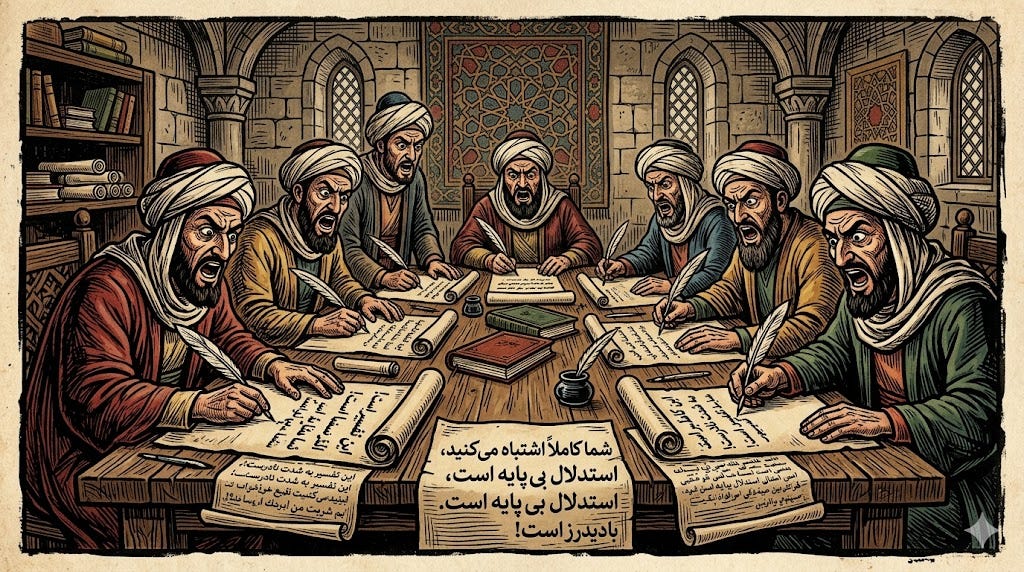
Discover the raw and unedited samples from the blood-soaked quills of medieval Muslim chroniclers

Read the Past Episodes


THE ELEVENTH CENTURY CHRONICLER, Al Utbi writes about sultan Mahmud of Ghazni’s treatment of Jayapaladeva, one of the noblest Hindu kings and heroes.
…Jayapala’s children, grandchildren, relatives, nephews, generals, and the “chief men of his tribe” were bound with ropes and carried before the Sultan, like as evildoers, on whose faces the fumes of infidelity are evident, who are covered with the vapours of misfortune, will be bound and carried to Hell… The Sultan directed that the polluted infidel Jaipal should be paraded about, so that his sons and chieftains might see him in that condition of shame, bonds, and disgrace and that the fear of Islam might fly abroad through the country of the infidels.
Next, he narrates what Mahmud did to Nawasa Shah, who had done Ghar Wapsi — i.e., he had reverted to his ancestral Hindu Dharma.
Satan had got the better of Nawasa Shah, for he was again apostatizing towards the pit of plural worship, and had thrown off the slough of Islam, and held conversation with the chiefs of idolatry respecting the casting off the firm rope of religion from his neck. So the Sultan went swifter than the wind in that direction, and made the sword reek with the blood of his enemies…then cut down the harvest of idolatry with the sickle of his sword and spear. After God had granted him this and the previous victory, which were tried witnesses as to his exalted state and proselytism, he returned without difficulty to Ghazna.
We can now turn to Hasan Nizami, a chronicler of Muhammad of Ghori’s period.
Kutub-ud-din [Aibak], on whose fortunate forehead the light of world-conquest shone conspicuous... purged by his sword the land of Hind from the filth of infidelity and vice, and freed the whole of that country from the thorn of God-plurality, and the impurity of idol-worship, and by his royal vigour and intrepidity, left not one temple standing.
Nizami is ecstatic at the invasion of Ajmer by Ghori.
The victorious army...departed towards Ajmer. When the crow-faced Hindus began to sound their white shells on the backs of the elephants, you would have said that a river of pitch was flowing impetuously down the face of a mountain of blue. The army of Islam was completely victorious, and a hundred thousand grovelling Hindus swiftly departed to the fire of hell. He destroyed (at Ajmer) the pillars and foundations of the idol temples, and built in their stead mosques and colleges, and the precepts of Islam, and the customs of the law were divulged and established.
Then we have the fanatical lament of the selfsame Ziauddin Barani who still can’t come to terms with the fact that Hindustan is still not fully converted, that the infidels are not properly oppressed.
What is our defence of the faith, cried Sultan Jalaluddin Khalji, that we suffer these Hindus, who are the greatest enemies of God and of the religion of Mustafa, to live in comfort and do not flow streams of their blood?
In the previous part of this series, we’ve seen how Amir Khusrau described the “splendour” of Islam in Hindustan where “our holy warriors, has become like a forest denuded of its thorns by fire. Islam is triumphant, idolatry is subdued.”
Both Barani and Khusrau were close disciples of the Sufi bigot Nizamuddin Auliya. The fact that an important train station in Delhi is after Nizamuddin is just another prime indicator of the ingested dhimmitude on the part of the Hindus.
Aside, like all loyal skull-cap grandees of Hindu secularists, the late Girish Karnad dutifully swallowed Barani’s bigotry and used his “history” to write his play, Tughlaq.
And here’s Qazi Mughisuddin, who doubled up as a legal advisor to Ala-ud-din Khalji. This is his prescription on how the sultan should treat the Dhimmi infidel Hindus:
The Hindu should pay the taxes with meekness and humility coupled with the utmost respect and free from all reluctance. Should the collector choose to spit in his mouth, he should open the same without hesitation, so that the official may spit into it… God Almighty Himself (in the Quran) commands their complete degradation in as much as these Hindus are the deadliest foes of the true prophet.
Indeed, a glowing model of Islamic religious tolerance and composite culture.
These examples are less than a fraction of the Himalayan volumes of such histories written firsthand by these medieval Muslim chroniclers. All available in public domain for the interested reader.
We shall look at one last example that perfectly illustrates another facet of the psyche of these chroniclers. This is Minhaj-us-Siraj, a sycophant par excellence, writing about the barbarian, Balban.
The Almighty desired to grant support to the power of Islam and to the strength of the Muhammadan faith, to extend his glorious shadow over it, and to preserve Hindustan within the range of his favour... He therefore removed… [Balban] in his youth from Turkistan, and separated him from his race...and conveyed him to the country (of Hindustan)... His success was so great that other nobles began to look upon it with jealousy, and the thorn of envy began to rankle in their hearts. But it was the will of God that he should excel them all, so that the more the fire of their envy burnt, the stronger did the incense of his fortune rise from the censer of the times.
This is the exalted art of culling sycophancy from divine sources. Minhaj-us-Siraj’s work must be made a prescribed textbook for the courtiers and concubines of the Congress party.
Divine Hypocrisy
The fifth trait of these medieval Muslim chroniclers is their behaviour in three important circumstances: one, when their favourite sultan or marauder is defeated; two, when he attacks other Muslim rulers and invaders; and three, when he violates the tenets of Islam in his quest for political power. The hypocrisy comes a full circle on all three counts. Thus, Mahmud of Ghazni’s unfruitful siege at Kalinjara (modern day Bundelkhand) is glossed over and even whitewashed as his “benevolence” instead of a retreat. Iltutmish’s defeat and killing of his arch foe Taj-ud-din Yildiz is described in polite terms by Hasan Nizami. Then our familiar culprit Minhaj-us-Siraj is conspicuously silent about Balban’s unscrupulous usurpation of power from his own son-in-law.
THE SIXTH AND FINAL trait of these chroniclers is an almost yawning absence of any description of the life of the common people of Hindustan. For two important reasons. Given the exalted position they enjoyed in the ruling class, they spent most of their time finding ways to fawn over their patrons and were busy in alcohol and debauchery. The second reason directly relates to the basic nature of an Islamic despotism especially in India. The majority were Hindus meant to be oppressed and exploited and not governed. Thus, the chroniclers who followed their tyrannical masters were similarly busy devising more innovative ways of oppressing the Kaffirs and Dhimmis. This is the picture of a typical Muslim rule as late as the nineteenth century.
If… we turn our eyes to the present Muhammadan kingdoms of India, and examine the character of the princes, and the condition of the people subject to their sway, we may…draw a parallel between ancient and modem times…we behold kings… sunk in sloth and debauchery, and emulating the vices of a Caligula… we can gather, that the common people must have been plunged into the lowest depths of wretchedness and despondency.… Should any…functionary entertain the desire of emulating the ‘‘exceedingly magnifical structures of his Moghal predecessors, it will check his aspirations to learn, that beyond palaces and porticos, temples, and tombs, there is little worthy of emulation…in the long line of Dehli Emperors, the comfort and happiness of the people were never contemplated by them ; and with the exception of a few serais and bridges…he will see nothing in which purely selfish considerations did not prevail… there is not one which subserves any purpose of general utility.
These words were written by the outstanding duo that over a decade, painstakingly recovered, collated, and indexed the primary source histories of medieval Muslim chronicles: Elliot and Dowson, compilers of the majestic History of India as told by its own Historians in eight volumes. Still the standard volumes. Still the unremovable thorn in the flesh of the Aligarh school charlatans and Marxist distorians.
Whitewashing and Erasing the Present
The psyche has remained the same. Only, the tactics and methods have changed in vastly altered political landscapes and world order. It is precisely because of this change that whitewashing of these firsthand chroniclers became an urgent imperative. Utbi, Siraj, Nizami, Barani, and Ferishta were at least candid about their perverse bigotry. But that’s part of remote history.
However, what is the manner in which the present is being chronicled across the world? Censorship. Shadow bans. Downgrading or disappearing Google search results. Prohibition on the usage of certain terminology. The mythical Islamophobia. And who are actually implementing all these? Non-Muslims. In the case of India, the current generation of the secularist brood, most of who are Hindus.
And what will be the exact nature of the history of 21st century Islam that two generations from now will read?
See the far-reaching consequences of examining just one minuscule aspect called the psyche of the medieval Muslim chroniclers?
|| Om Tat Sat ||
Concluded